

图片来源:AutoHaina Media
BMW China’s sixth-generation battery technology entered mass production at the Shenyang production base today, October 15, 2026. This expansion, representing an investment of 10 billion yuan (1.5 billion USD), covers a facility area of 240,000 square meters – five times the size of BMW’s existing battery production footprint in the region.
The new battery technology is set to power BMW’s upcoming “Neue Klasse” (New Generation) models, with the iX3 and i3 serving as the first recipients. To demonstrate the capabilities of this new platform, BMW showcased the i3 50L, a pure electric sedan tailored specifically for the Chinese market, which recently completed a long-distance endurance challenge.
During the test, the i3 50L covered 1,213 km on a single charge, arriving at its destination with 1% battery remaining. This result represents a 118% range achievement rate against its official rating, setting a new long-distance road test record for the brand. The vehicle maintained an exceptionally low energy consumption of 8.8 kWh per 100 km throughout the journey, which included a mix of highway, national road, and urban driving conditions.
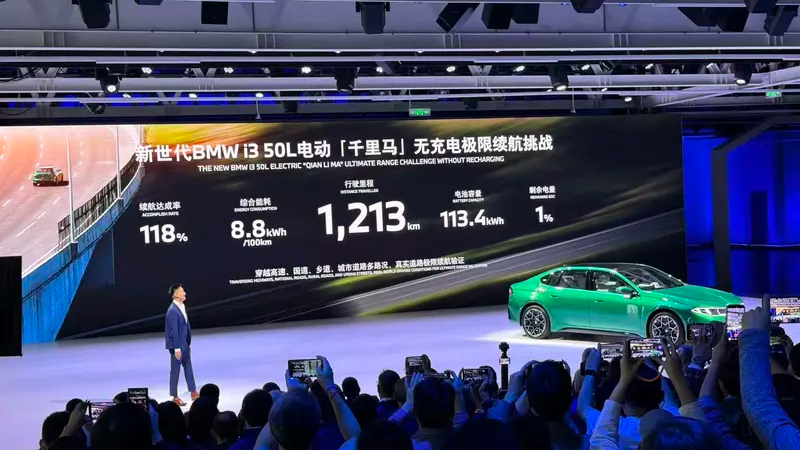
The test vehicle, based on the native “Neue Klasse” electric platform, is equipped with a 113.4 kWh large cylindrical battery and an 800V high-voltage architecture. The system supports fast charging up to 400 kW, capable of adding 400 km of range in 10 minutes. While the test featured a rear-wheel-drive model, the i3 lineup will also include a dual-motor all-wheel-drive variant, boasting a system maximum power of 345 kW (463 hp) and 645 Nm of peak torque.
BMW Group Chairman Dr Oliver Zipse emphasised the company’s commitment to the Chinese market during the launch ceremony, stating that the proportion of BMW models produced locally in China is expected to rise to over 95% by 2030. The new iX3 began pre-orders in August 2026, with deliveries scheduled to commence in November, while the i3 is slated for production and market launch by BMW Brilliance in the fourth quarter of this year.
This i3 being used for testing most likely uses the same battery as the iX3. The 50L version of the new BMW iX3 uses large cylindrical ternary lithium cells supplied by EVE Energy, while the other versions use cells supplied by CATL.
Source: CarNewsChina (View original)