

Image source: AutoHaina Media
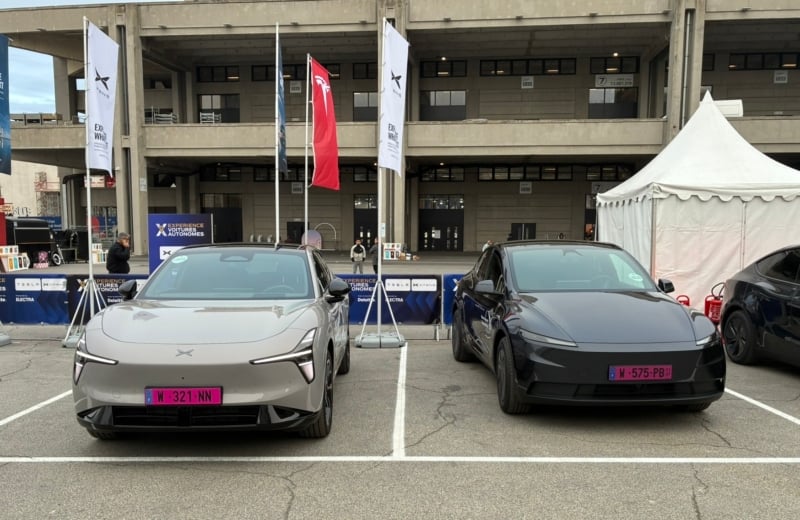
Tesla and Xpeng were the only two of 60 automakers to offer test drives on Paris’s chaotic streets at the 2026 Paris Motor Show (PMS). After trying Xpeng’s NGP VLA 2.0 in Beijing in April, I was naturally curious how it would handle European traffic in France’s capital. For Xpeng, this is its first large-scale NGP test-drive event in Europe.
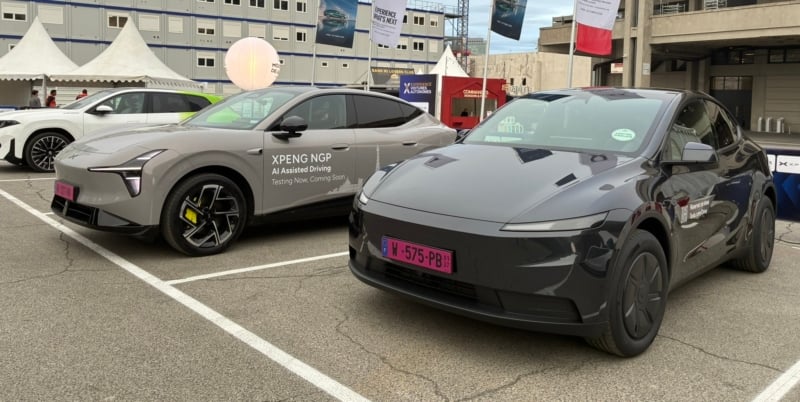
NGP stands for Navigation Guided Pilot, Xpeng’s intelligent driving system. VLA 2.0 (Vision-Language-Action) is the latest AI model powering the NGP. In Paris, Xpeng offered supervised NGP drives on a pre-planned route for about 30 minutes, with a safety driver ready to intervene if needed. The event was part of PMS’s official Autonomous Lab venue, which hosted only two automakers.
We “drove” the Xpeng L03, a mid-size coupe SUV known in China as the Xpeng Mona L03. Unlike FSD, NGP isn’t vision-only: it’s vision-based, meaning it relies mainly on cameras, but it also takes input from two other sensor types, millimeter-wave radar and ultrasonic sensors.
This isn’t the first time Xpeng has showcased NGP in Europe; it previously held small-batch test rides in Amsterdam and also in Munich in July. However, the current tests were longer than the few minutes in Munich and Amsterdam, showing Xpeng’s (or NGP’s) growing confidence in its ability to adapt intelligent driving for European conditions. Also, Paris’s urban roads differ from Munich’s experience.
In Beijing, it was less chaotic (at least in the area where the rides were conducted), and the VLA 2.0 model felt pretty mature and well validated in local conditions. I sat behind the wheel with a great guy, Augustin Friedel, and barely needed to intervene. We briefly tried highways and even small side roads on a pre-planned route; NGP stayed confident and handled unexpected situations well, and was very considerate of two-wheelers. What still needed some polishing was being less hesitant about lane changes, not missing opportunities, and merging into traffic. So I was curious how the adaptations to European conditions went, since Xpeng has had a new R&D center in Munich since September 2025, which handles localization.
Tldr – Xpeng did a pretty good job in adapting NGP to European traffic signs, roundabouts, narrow streets, and road walkers. It felt natural and confident in most urban scenarios we encountered. Especially for cycling lanes, two-wheelers, and pedestrians, the performance was great.
In the EU, when a pedestrian approaches a zebra crossing, the car must stop even if the pedestrian is not yet at the zebra, just showing intent to cross. In China, it is technically the same, but real-world scenarios are more complex, so I was especially interested in NGP behavior in those situations.
We didn’t have to wait long to find out. At a zebra crossing, the car stopped for a family who were clearly about to cross, exactly as I’d expect. It also navigated around a vehicle blocking our lane and handled cyclists well. It was much more confident around trucks than I would have been, though that might just be my trust issues with truck drivers.
Areas for improvement include lane-change decision-making and merging into traffic. The supervising driver made some interventions, but as she said, it was more about her feelings than necessity. She also took over when we returned to the expo venue to park.
All in all, I would say the adaptations to local traffic are pretty high quality, given the limited local data and the fact that Xpeng’s ADAS in the EU is just beginning. The pros and cons of VLA 2.0 in China are largely the same as what I experienced in Paris. That’s a good thing, since consistency is key here. It would definitely take more time to go deeper than a 30-minute ride, though.
Xpeng will bring NGP to its European customers in Q1 2027; we expect it will first deploy to the models equipped with the Turing chip (P7+ sedan, X9 MPV, L03 Ultra coupe SUV, and the new G9L seven-seater SUV). Deployment to models with Nvidia’s Orin is unknown. We will keep an eye on it.
Source: CarNewsChina (View original)